

10 Lessons Learnt Setting Up OpenClaw | Celebrating my Webby Nominations & New Courses

I woke up to some surreal news. My course business has been nominated for The Webby Awards 🤯🤯 These were described to me as the ...Oscars of the Internet. They have been around since 1996 (literal infancy of the web) and are the most respected global honor for digital excellence.
When I started my AI PM certification and bootcamp, I just wanted to build something that didn't exist, in order to help train the next generation of AI Product Leaders. I didn't expect to see our name alongside global brands and industry leaders, let alone the Webby Awards.

As it turns out, out of ~15k+ entries, my Academy was selected for 2 categories and we are officially competing for the People’s Voice Award in these two categories 👇
𝟭. 𝗖𝗿𝗲𝗮𝘁𝗼𝗿 𝗠𝗮𝘀𝘁𝗲𝗿𝗰𝗹𝗮𝘀𝘀 𝗼𝗿 𝗟𝗲𝗮𝗿𝗻𝗶𝗻𝗴 𝗣𝗿𝗼𝗴𝗿𝗮𝗺:
https://lnkd.in/gX5ikSyX
𝟮. 𝗖𝗿𝗲𝗮𝘁𝗼𝗿-𝗟𝗲𝗱 𝗣𝗿𝗼𝗱𝘂𝗰𝘁 𝗼𝗿 𝗦𝗲𝗿𝘃𝗶𝗰𝗲:
https://lnkd.in/gYiRNnEe
If you have a spare moment to support my independent creator business, you can cast your vote.
Thank you for being part of this story and there’s more to come as my Academy is further expanding with new courses, and my partnership with Diego Granados.
I set up Openclaw. Here’s what I learned.
I’m setting up Openclaw. I’m not gonna lie, there were so many tricky steps during the process. But I did it!
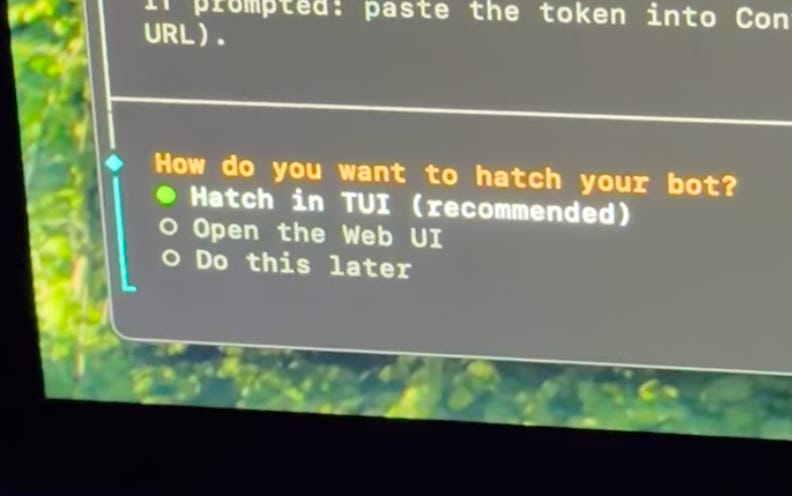
Here are 5 learnings I took away after setting up OpenClaw.
1. The setup friction is the real moat
Everyone loves the polished demo. Very few people enjoy the actual setup.
You have to deal with API keys, permissions, terminals, configs, authentication, and all the little issues that make you wonder whether it is worth it.
But that is exactly the point.
This friction is what separates passive AI consumers from real builders. If you can get through setup, you immediately start seeing the landscape differently. You stop thinking in abstract terms like “agents will change everything” and start seeing the actual operational reality of what it takes to make them useful.
2. An agent becomes interesting only when it can actually do things
Without tools, an agent is mostly just a conversation layer.
Interesting, yes. Useful, sometimes.
Transformative, not really.
The moment you connect it to the right systems, that changes. Then it can search, message, retrieve, update, trigger, monitor, or coordinate. That is when it starts feeling less like a chatbot and more like an actual worker in your stack.
That shift was one of the clearest takeaways for me: the intelligence matters, but the tool access matters just as much.
3. Reliability matters more than the wow factor
A flashy success is easy to remember.
A reliable workflow is much harder to build.
When setting up OpenClaw, what stood out to me was not whether it could do one impressive thing once. It was whether I could imagine trusting it repeatedly. That is the real standard for agentic products.
This is also where many AI products will win or lose. Not on whether they can produce a magical moment, but on whether they can do the boring, useful thing consistently enough that users actually change their behavior.
4. You do not just install the tool — you design the workflow
This was probably the biggest product lesson.
Setting up an agent is not just a technical exercise. It is a workflow design exercise. You have to think through questions like:
Where does the task start?
What tools should the agent have access to?
What should it do automatically versus ask permission for?
What happens when it fails?
When should a human step in?
That is why I think PMs should pay very close attention to this space. Agentic products are about orchestration, permissions, trust, fallbacks, and user confidence. That is deeply product work.
5. The LLM Choice Dictates the “Personality”
OpenClaw is an interface, but its “brain” depends on your API key.
Claude 3.5/4: Great for nuanced communication and “safe” coding.
DeepSeek-V3: Incredibly cost-effective for high-volume background tasks (like lead gen).
GPT-4.5: The most reliable for complex, multi-step autonomous workflows.
Lesson: Mix and match. I settled on using Claude Code for development tasks and Ollama (local) for private document processing.
6. Your “Skills” Workspace is Your Superpower
OpenClaw uses a unique skills system where functionality is stored in simple SKILL.md files. Don’t reinvent the wheel. Check ClawHub for pre-made skills before trying to code your own.I found that workspace-specific skills always take precedence. If you have a custom prompt for a specific project, keep it in that directory to keep your agent from getting confused.
7. Hosting Matters: Local vs. 24/7 VPS
I started by running OpenClaw locally on my Mac Mini (the “lobster way”), but quickly realized an autonomous agent isn’t very helpful if it goes to sleep when you close your laptop. For true automation (like 5 AM morning briefings), you need a VPS. Services like ClawRunway offer one-click deployments if you want to skip the SSH and Docker headaches.
8. Managing Token “Cost Traps”
Autonomous agents are chatty. If you leave OpenClaw in a loop trying to solve a coding bug, it can burn through $50 of API credits in an hour. Set hard limits in your LLM provider dashboard (OpenAI/Anthropic) and use OpenClaw’s built-in Human-in-the-loop approvals for high-cost actions.
9. PMs who build with these tools now will have an unfair advantage
A lot of people are still consuming content about AI.
Far fewer are actually setting up systems like this themselves.
10. That gap matters.
Because once you go through the setup yourself, your questions get better. Your intuition gets sharper. Your product judgment improves. You start seeing the difference between a nice demo and a robust workflow. You start spotting failure points earlier. You start understanding where value really comes from.
And honestly, I think this is where the next wave of great PMs will stand out: not by having opinions on AI, but by having hands-on experience building with it.
That is why I keep telling PMs the same thing: do not just watch the agentic era happen. Install the tools. Break things. Connect systems. Test workflows. See the edge cases for yourself.
After setting up OpenClaw, I left with sharper intuition for where agentic products are real, where they are fragile, and where PMs can create massive value.
Courses
Openclaw & Claude Code Certification with N8N and antigravity

Join our sold-out course, it offers a certification for OpenClaw and Claude Code + N8N + Antigravity, for those enrolling we can send a mac mini for free (or price without mac mini).
My #1 AI PM Certification kicks off next week.
Celebrating out Webby nomination, we have a 2 for 1 offer for those interested in joining!
Use this link 241VAL24H
Bring one colleague or friend free
After enrolling, email maven@aiproduct.com with their details and we’ll add them, valid for 24h.
I’m partnering with my friend Diego Granados on more courses and private trainings, in a different format. We will be announcing them here soon! We are also collecting a list of sponsors for our newsletter. In the meantime, feel free to respond to this email to say hello, or reach out on instagram.
setup friction is underrated as a moat.
teams that pushed through the configuration grind early built the model-adapter muscle everyone is scrambling for after this week.